DEI in African Tech: What’s Real, What’s Not, and Why It Matters

Photo by Christina @ wocintechchat.com on Unsplash
DEI in African Tech: What’s Real, What’s Not, and Why It Matters
By Mikey San
The Event That Sparked This Thought
Today, I came across a post from CHAOSS Project Africa on X. They were counting down to their upcoming event in Lagos on August 13th, promising conversations around open source project health metrics, DEI, sustainability, and more.
The mention of DEI caught my attention. Not because I’m against the idea — but because I’ve always wondered how it fits into the African tech conversation.
Tech on our continent is still relatively young. DEI, on the other hand, feels like a topic that’s been shaped by much older, more established tech ecosystems elsewhere. Was I missing something? Or was this just another example of taking a Western corporate conversation and trying to fit it onto a very different landscape?
That little question is what set me off down this rabbit hole.
Defining DEI in an African Tech Context
Before we get into the weeds, let’s strip the jargon back.
- Diversity: Having different genders, ages, ethnicities, abilities, and perspectives represented in the tech workforce.
- Equity: Making sure access to opportunities, capital, and leadership roles is fair — not stacked in favour of one group.
- Inclusion: Ensuring all groups feel supported, valued, and able to contribute fully.
In the West, DEI often comes from a place of repairing past wrongs — fighting racial segregation, pushing for gender equality in leadership, dismantling workplace discrimination.
In Africa? The picture’s different. We didn’t have a “tech old boys’ club” 50 years ago because… well… we didn’t really have a tech industry at all. So if DEI applies here, it has to be in our own context — not just copy‑pasted from Silicon Valley HR manuals.
The Numbers: Africa vs. the Rest
Past five years, the figures tell us:
Women in tech workforce
- Africa: ~30%
- US/EU: ~25–35%
Female tech founders
- Africa: ~14–15%
- US/EU: ~15%
Female CEOs in start-ups
- Africa: ~9–10%
- US/EU: ~15–20%
VC funding to female-led start-ups
- Africa: ~7–9%
- EU: ~2–3%
- US: ~2%
At entry level, Africa’s numbers are not dramatically worse than the global average. But at leadership and funding levels, the gap is still wide.
Where DEI Really Matters in African Tech
If we stick to DEI’s actual meaning — inequities linked to identity — here’s where it’s relevant:
- Gender leadership gaps: Women make up nearly a third of Africa’s tech workforce but less than 10% of CEOs.
- Capital bias against women founders: Women-led start-ups get only a fraction of the funding available to men.
- Disability exclusion: Few accelerators, training programs, or employers are set up for persons with disabilities.
- Ethnic or tribal bias in hiring: Some founders still hire mainly from their own ethnic networks.
- Age bias: Older professionals (40+) are often passed over in favour of younger start-up talent.
These are identity-based gaps — and they deserve targeted, deliberate fixes.
Where DEI Gets Misapplied
Then there are the things often filed under “DEI” that really aren’t about identity at all.
- Francophone vs. Anglophone funding gap: English is the global language of tech investment. Investors lean towards English-speaking hubs like Nigeria, Kenya, and South Africa — not because they dislike Francophone founders, but because it’s easier to operate in English.
- Urban vs. rural tech access: Poor broadband, patchy electricity, and limited devices block participation — for everyone in those areas.
- Investor hub bias: Nairobi, Lagos, and Cape Town get most of the capital because of their track records and networks.
- Regulatory barriers: Complicated registration processes, FX restrictions, and tax headaches push investors towards easier markets.
- Global dominance of English: Founders pitching in English connect faster with global capital.
These are ecosystem maturity and market structure challenges. Fixing them takes policy changes, infrastructure investment, and cross‑border collaboration — not diversity workshops.
True DEI (Identity-Based Inequities)
- Gender leadership gaps — Women are ~30% of tech workforce but <10% of CEOs.
- Capital bias against women founders — Women-led startups get only 7–9% of VC despite ~15% being founders.
- Disability exclusion — Lack of adaptive tools and accessible workplaces.
- Ethnic/tribal bias in hiring — Hiring from own ethnic group limits diversity.
- Age bias — Excluding experienced professionals in favour of youth culture.
Ecosystem Maturity / Market Structure Issues
- Language network effects — English-speaking hubs attract more investment.
- Francophone vs. Anglophone funding gap — Investor familiarity, regulatory ease, not identity bias.
- Investor hub bias — Lagos, Nairobi, Cape Town dominate because of maturity and networks.
- Urban vs. rural tech access — Infrastructure gaps affect all equally.
- Regulatory barriers — Policy and bureaucracy slow investment.
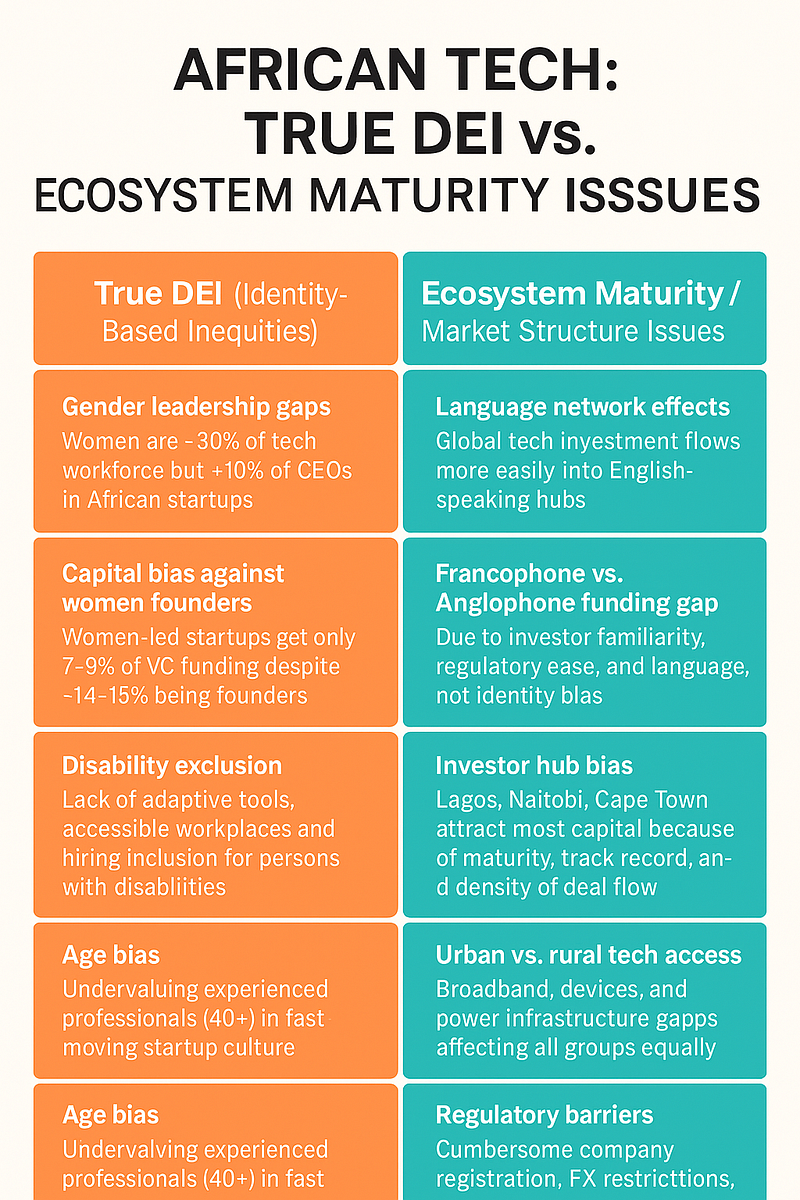
Infographic: True DEI vs. Ecosystem Issues
Why This Distinction Matters
If we confuse market structure gaps with true DEI inequities:
- We risk fixing the wrong problems with the wrong tools.
- We waste resources.
- We allow real identity-based inequities to be drowned out by unrelated debates about “fairness” that are actually about market maturity.
So, What Should We Do?
- Target DEI where it’s real — mentorship for women leaders, accessible training for disabled workers, anti‑bias hiring practices.
- Tackle market structure issues separately — harmonise regulations, build bilingual investor networks, invest in infrastructure.
- Shape our own definitions — DEI in Africa should reflect our context, not just copy global talking points.
Final Thought
African tech is young. That’s both a challenge and a gift.
We have gaps to close, yes. But we also have the rare opportunity to shape our ecosystems from the ground up — to avoid importing the entrenched inequities and culture wars of older tech markets.
So let’s keep DEI where it belongs: focused on identity-based fairness. And let’s stop calling every market gap a “diversity issue.” Not every barrier is bias — and not every imbalance is discrimination.